Want to learn more about surgical guide planning?
Discover how digital workflows can improve your implant success rates.
Table of Contents
Your Guide Is Only as Good as Your Scan
A surgical guide is a precision instrument. But precision in, precision out. If your CBCT data contains errors, every downstream step — implant planning, guide design, and the surgery itself — inherits those errors.
A 3D-printed template that fits over the patient's teeth or tissue and directs drill placement during implant surgery. It transfers the digital treatment plan into precise physical drill positions.
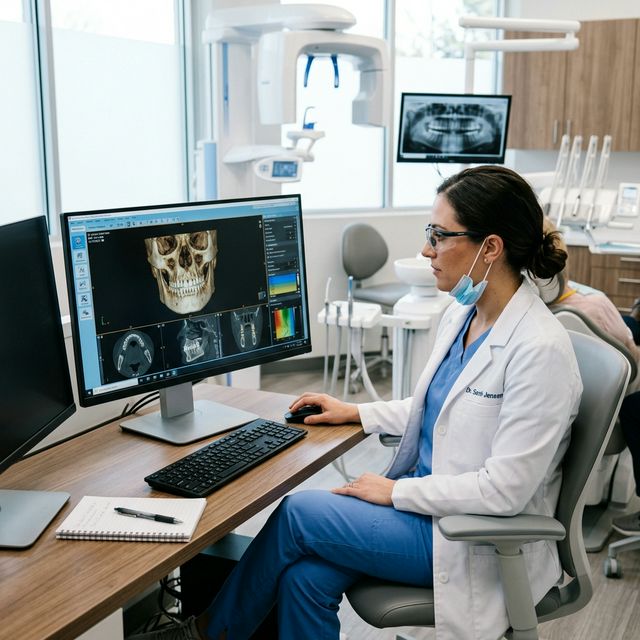
A 3D imaging technique that captures the jaw, teeth, and bone structure in a single rotational scan. It produces DICOM files used for implant planning, nerve mapping, and surgical guide design.
After reviewing thousands of cases, we've identified the five most common CBCT mistakes that compromise guide accuracy. Fix these, and your guides will fit better, your surgeries will be smoother, and your revision rate will drop.
---
1. Patient Movement During the Scan (Motion Artifact)
The Problem: Even a small head movement during a CBCT scan creates "ghosting" — blurred or doubled structures. This makes it impossible to accurately identify bone margins, nerve canals, or root positions.
Why It Matters for Guides: Motion artifact shifts the apparent position of teeth and bone by 0.5–2mm. Your guide is designed to fit these structures. If they're in the wrong place on the scan, the guide won't seat properly.
The Fix:
- Use a chin rest and head stabilizer
- Instruct the patient not to swallow during the scan
- For anxious patients, do a "practice run" without radiation
- Review the scan immediately — rescanning is cheaper than a failed guide
---
2. Metal Scatter from Existing Restorations
The Problem: Crowns, bridges, implants, and even amalgam fillings create bright "star burst" artifacts on CBCT. These obscure the actual anatomy underneath.
Why It Matters for Guides: If the occlusal surfaces are hidden by scatter, the STL-to-CBCT registration (superimposition) becomes inaccurate. This means the planned implant position shifts relative to the actual teeth — sometimes by several millimeters.
The Fix:
- Remove any removable prosthetics before scanning
- Use scatter reduction protocols available on most modern CBCT units
- If extensive metal is present, ensure the intraoral STL scan is high-quality — the software can use it to "replace" the distorted CBCT dentition
> Pro Tip: When submitting a case with heavy metal artifact, always include a note. Our planning team uses specialized registration techniques for these situations.
---
3. Incorrect Field of View (FOV) Selection
The Problem: Choosing a FOV that's too small crops out critical anatomy. Choosing one too large increases radiation dose and reduces resolution.
Why It Matters for Guides:
- Too Small: Missing the occlusal surfaces means no reliable registration with the intraoral scan. Missing sinus or nerve anatomy means unsafe planning.
- Too Large: Lower resolution makes it harder to distinguish cortical bone boundaries, reducing placement accuracy.
The Fix:
- For single implants: Select a FOV that captures the target site plus at least 2 adjacent teeth on each side
- For full-arch: Use the largest FOV, but ensure the scan includes the full occlusal plane
- Always check: Can you see the mental foramen? The sinus floor? The opposing occlusion?
---
4. Poor Patient Positioning (Tilted Scans)
The Problem: If the patient's head is tilted or rotated during the scan, the resulting DICOM data is skewed. While software can correct some of this, extreme tilts reduce image quality in the region of interest.
Digital Imaging and Communications in Medicine — the universal file format for medical imaging. CBCT scanners produce DICOM files that are imported into planning software for 3D reconstruction.
Why It Matters for Guides: A tilted scan causes the reconstruction plane to cut through bone at an angle, distorting cross-sections. Bone height and width measurements become unreliable, and implant angulation calculations are based on skewed geometry.
The Fix:
- Align the patient's Frankfort plane (tragus to infraorbital rim) horizontally
- Use the CBCT unit's built-in positioning lasers
- Verify positioning on the scout image before the full scan
---
5. Outdated Scans (Using Old CBCT Data)
The Problem: Bone remodels. Teeth shift. A CBCT scan taken 6+ months ago may no longer represent the patient's current anatomy — especially after extractions, bone grafts, or orthodontic treatment.
Why It Matters for Guides: A guide designed on outdated data won't seat correctly because the bone ridge or adjacent teeth have changed. In grafted sites, the bone volume may differ significantly from the original scan.
The Fix:
- For uncomplicated cases: CBCT should be no older than 3 months
- For post-extraction or grafted sites: Rescan immediately before planning
- Always include the date of the CBCT in your submission — we'll flag if it seems outdated
---
The Bottom Line
Garbage in, garbage out. A $150 surgical guide designed on a flawed CBCT scan is worthless. A $50 rescan is the cheapest insurance policy in implant dentistry.
Before your next case, run through this checklist:
- No motion artifact visible
- Metal scatter is manageable
- FOV includes all relevant anatomy
- Patient was positioned correctly
- Scan is less than 3 months old
If you check all five boxes, your guide accuracy will be in the top tier.
> Not sure if your scan is usable?
> Send it to our team for a free assessment — we'll tell you before you order.
Ready to streamline your surgical guide workflow?
Join 200+ dental professionals who trust SurgicalGuide.Pro for precision planning.