Want to learn more about surgical guide planning?
Discover how digital workflows can improve your implant success rates.
Table of Contents
Buying a 3D printer sounds like an obvious investment. Print your own surgical guides, skip the lab fees, and own the entire workflow. The marketing materials make it look like a guaranteed return on investment.
A 3D-printed template that fits over the patient's teeth or tissue and directs drill placement during implant surgery. It transfers the digital treatment plan into precise physical drill positions.
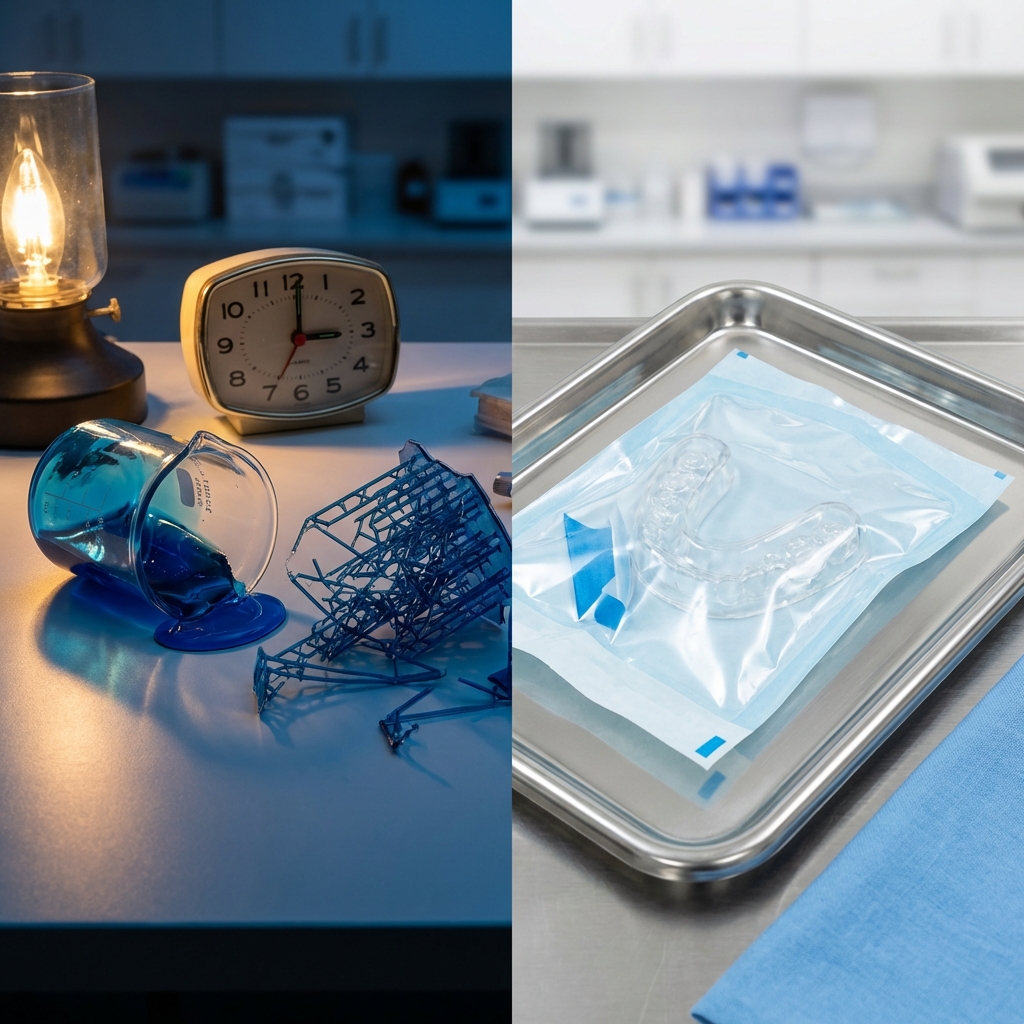
But the financial reality is more nuanced. In-house 3D printing carries significant hidden costs that most purchase calculations ignore.
The Visible Costs
These are the numbers vendors put in the brochure:
- Printer purchase: $3,000 - $15,000 for a dental-grade resin printer
- Resin per guide: $5 - $15 in material cost
- Post-processing station: $500 - $2,000 for UV curing and washing
At face value, each guide costs $5-15 to print. Compared to outsourcing at €80-150, the math looks compelling.
But the brochure stops here. Reality does not.
The Hidden Costs Nobody Mentions
Staff Time
Someone must operate the printer — loading resin, starting prints, monitoring for failures, post-processing, cleaning. For a busy clinic, this is clinical staff time diverted from revenue-generating activities.
Real cost: 30-60 minutes per print cycle, at $30-50/hour staff rates = $15-50 per guide in labor.
Failed Prints
Resin printers fail. Supports detach, layers delaminate, build plates lose adhesion. Industry-average failure rates for dental prints run 5-15%.
Real cost: Each failed print wastes $5-15 in resin plus 30+ minutes of machine time.
Maintenance and Consumables
- FEP film replacement: every 50-100 prints ($20-50 each)
- Resin tank replacements: every 3-6 months ($100-200)
- Build plate resurfacing: quarterly
- Isopropyl alcohol for washing: ongoing consumable
- Calibration time: periodic but unavoidable
Real cost: $50-100/month in consumables that never appear in ROI calculations.
Software Licenses
Design software for surgical guides is not free. Professional planning platforms cost $200-500/month — whether you print 2 guides or 20.
Real cost: $2,400-6,000/year in software subscriptions.
Validation and Quality Control
Printed guides require dimensional verification. Without checking sleeve tolerances and fit, you risk guide inaccuracy in the operating room. This means calibration tools, test prints, and quality audits.
Obsolescence
3D printing technology evolves rapidly. Today's $10,000 printer will be outperformed by a $3,000 model in 2-3 years.
The Real Per-Guide Cost
When all hidden costs are included:
| Cost Component | Per Guide |
|---|---|
| Material | $5-15 |
| Staff labor | $15-50 |
| Failed print amortization | $2-5 |
| Consumables | $3-8 |
| Software license | $10-25 |
| Maintenance | $2-5 |
| Total real cost | $37-108 |
Suddenly, outsourcing at €80-150 per guide does not look expensive. It looks efficient.
When In-House Printing Makes Sense
In-house printing is justified when:
- You print 20+ guides per month (achieving volume economies)
- You have dedicated lab staff (not diverting clinical time)
- You already own the planning software
- You value same-day turnaround for urgent cases
When Outsourcing Wins
Outsourcing is better when:
- You print fewer than 15 guides per month
- Your staff time is better spent on patient care
- You want predictable, fixed per-case costs
- You prefer zero capital expenditure
When Digital Implant Planning Should Be Outsourced
The decision to outsource is not about capability — it is about efficiency. Most clinics that try in-house digital implant planning discover the same pattern: the first 10 cases are exciting, the next 50 are routine, and by case 100 the clinician realizes they are spending surgical hours on CAD work.
Digital implant planning should be outsourced when:
- Your implant volume is below 20 cases per month
- You do not have a dedicated CAD technician on staff
- Software license renewals exceed your outsourcing costs
- Your time is more valuable in the operatory than at a monitor
The most cost-effective model: outsource the digital planning and guide design, but keep the 3D printing in-house. You get professional-grade planning without the software overhead, and you maintain control over manufacturing timelines.
Ready to streamline your surgical guide workflow?
Join 200+ dental professionals who trust SurgicalGuide.Pro for precision planning.