Want to learn more about surgical guide planning?
Discover how digital workflows can improve your implant success rates.
Table of Contents
Introduction
Choosing the right type of surgical guide is crucial for achieving optimal implant placement
A 3D-printed template that fits over the patient's teeth or tissue and directs drill placement during implant surgery. It transfers the digital treatment plan into precise physical drill positions.
accuracy. The two most common types ” tooth-supported and tissue-supported guides ” each have
their
strengths and specific indications. Understanding when to use each type can significantly impact
your surgical outcomes.
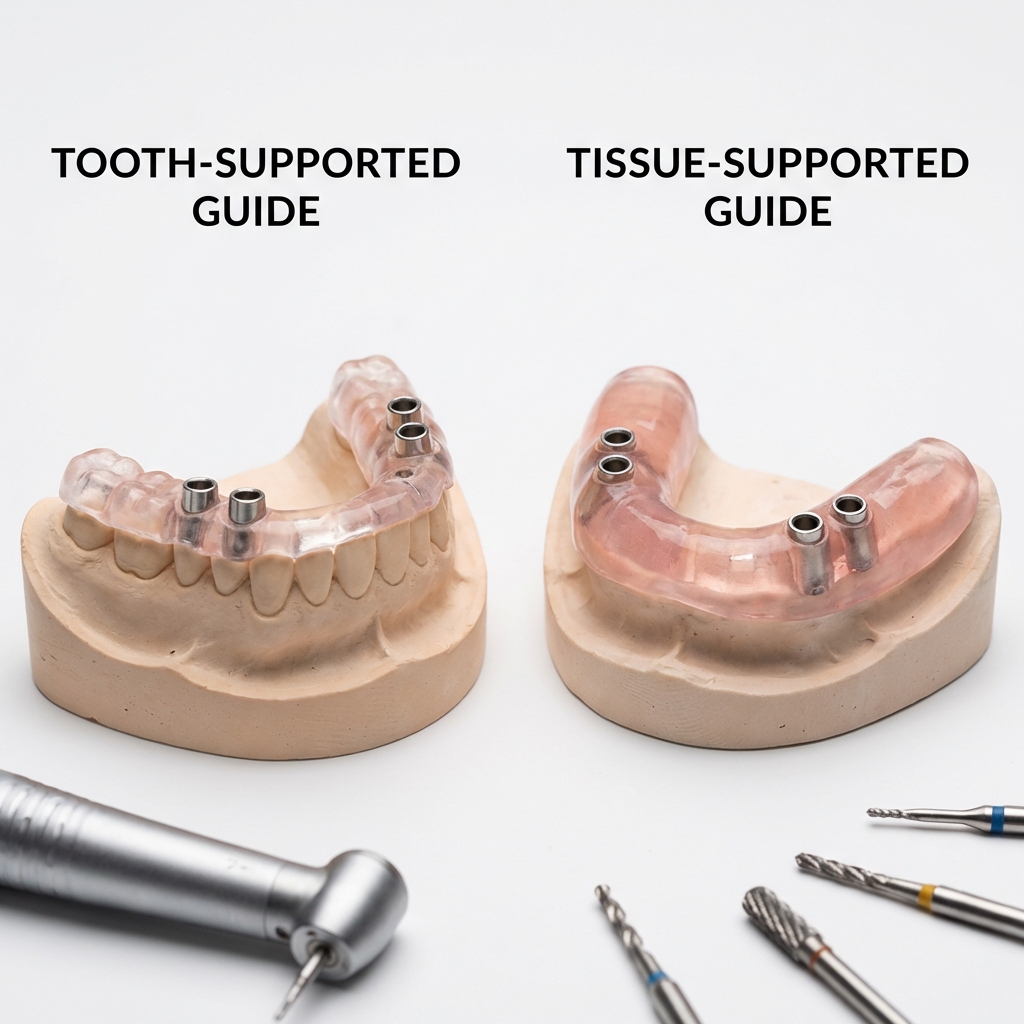
Tooth-Supported Guides
Tooth-supported guides rest on the remaining natural teeth, providing excellent stability and
positional accuracy. They are the gold standard when sufficient teeth are available for support.
Advantages
- Superior accuracy: Stable reference points from natural teeth
- Consistent seating: Clear positioning with tooth contact
- Minimal movement: During drilling procedures
- Easier verification: Of correct guide placement
Ideal Indications
- Partially edentulous cases with stable remaining teeth
- Single implant placements
- Cases requiring maximum precision
- Patients with good remaining dentition
> Pro Tip: For tooth-supported guides, ensure at least 3-4 stable teeth are available for support. Avoid
using mobile teeth or teeth planned for extraction as primary support.
Tissue-Supported Guides
Tissue-supported guides rest directly on the soft tissue (mucosa) and are essential for fully
edentulous cases where no teeth are available for support.
Advantages
- Applicable for fully edentulous cases: The only option when no teeth remain
- Full-arch visibility: Allows planning without tooth interference
- Flexibility: Can be combined with bone fixation pins
Considerations
- Soft tissue compressibility can affect accuracy
- Requires fixation pins for stability in most cases
- More technique-sensitive placement
- Proper mucosa thickness assessment is essential
Direct Comparison
Understanding the key differences helps in making informed decisions:
Factor
Tooth-Supported
Tissue-Supported
Accuracy
Higher (В±0.5mm)
Moderate (В±1-1.5mm)
Stability
Excellent
Requires pins
Indication
Partially edentulous
Fully edentulous
Learning curve
Lower
Higher
Selection Criteria
When choosing between guide types, consider these factors:
1. Number of remaining teeth: 3+ stable teeth = tooth-supported
- Teeth condition: Mobile or compromised teeth favor tissue support
- Case complexity: Complex cases benefit from tooth support when available
- Immediate extraction: Consider hybrid approaches
- Full-arch rehabilitation: Often requires tissue or bone support
Conclusion
Both tooth-supported and tissue-supported guides have their place in modern implant dentistry. The
key is matching the guide type to the clinical situation. When teeth are available and stable,
tooth-supported guides offer superior accuracy. For edentulous cases, tissue-supported guides with
proper fixation provide reliable results.
If you're unsure which type is best for your case, contact me
for a consultation. I can help you choose the optimal guide design based on your specific clinical
scenario.
Surgical Guides
Tooth-Supported
Tissue-Supported
Ready to streamline your surgical guide workflow?
Join 200+ dental professionals who trust SurgicalGuide.Pro for precision planning.