Want to learn more about surgical guide planning?
Discover how digital workflows can improve your implant success rates.
Table of Contents
I get this question from at least one dentist a week: "Do I actually need a surgical guide, or is it just the industry trying to sell me more software?"
A 3D-printed template that fits over the patient's teeth or tissue and directs drill placement during implant surgery. It transfers the digital treatment plan into precise physical drill positions.
The short answer is yes, they absolutely improve outcomes. But probably not for the primary reason you think. The obvious benefit is precision, but the real benefit is something much deeper.
The Obvious Benefit: Accuracy
We know from countless peer-reviewed studies that guided surgery places the implant closer to the digital plan. While freehand places you "somewhere in the bone," a high-quality guide ensures your osteotomy matches the exact pre-planned trajectory from the CBCT.
The surgical preparation of bone to receive a dental implant. Sequential drills of increasing diameter create a precisely sized channel for implant insertion.
An implant placement technique that uses a physical surgical guide to direct drills and implants to positions planned in 3D software. It improves accuracy and reduces surgical risks compared to freehand placement.
A 3D imaging technique that captures the jaw, teeth, and bone structure in a single rotational scan. It produces DICOM files used for implant planning, nerve mapping, and surgical guide design.
But accuracy alone doesn't perfectly correlate to clinical "survival" of an implant. An implant slightly off-center in thick bone will likely osseointegrate just fine. So why bother?
Explore our affordable surgical guide planning.
The Benefit Nobody Talks About: Predictability
The real benefit of a surgical guide is that the surgery becomes beautifully boring.
When you use a guide, you are essentially front-loading all the stress. You make the hard decisions about proximity to the sinus floor, nerve canals, and restorative emergence profile while sitting at your computer with a cup of coffee. When the patient is in the chair, you just drill exactly where the guide tells you to. There is no mid-surgery adrenaline spike. No second-guessing your angulation. That predictability is priceless.
The Benefit For Your Practice
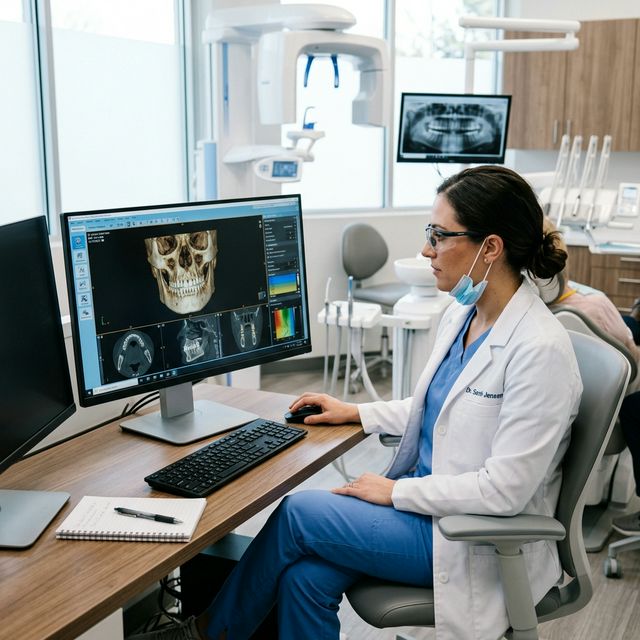
Case acceptance goes up dramatically when you show patients a 3D plan. When you bring a patient to the monitor, display their jaw, and say, "We have a 3D printed guide that essentially acts like a GPS for your surgery," they feel incredibly safe. It elevates you from a standard dentist to a high-tech specialist in their eyes.
The Honest Downsides
I will not pretend guides are perfect. They come with downsides:
- Extra Cost: The digital design adds a fee to the overhead. (Though our tooth-supported designs at $80 are easily absorbed into the case fee).
- Workflow Delay: You have to wait 2-3 days for the design and printing process.
- Mouth Opening Limits: Patients with severe trismus may struggle entirely with the vertical height of guided drill keys in posterior regions.
Who Shouldn't Bother (Yet)
If you place two implants a year, the learning curve of understanding guided kits and software might not be worth your time right now. But if you are placing 10 or more implants a year, you are leaving money, efficiency, and safety on the table by ignoring guided surgery. The peace of mind alone is worth the shift.
Ready to streamline your surgical guide workflow?
Join 200+ dental professionals who trust SurgicalGuide.Pro for precision planning.