Want to learn more about surgical guide planning?
Discover how digital workflows can improve your implant success rates.
Table of Contents
Placing dental implants without a surgical guide is like driving without GPS. You might reach the destination, but the route will be longer, riskier, and far less predictable.
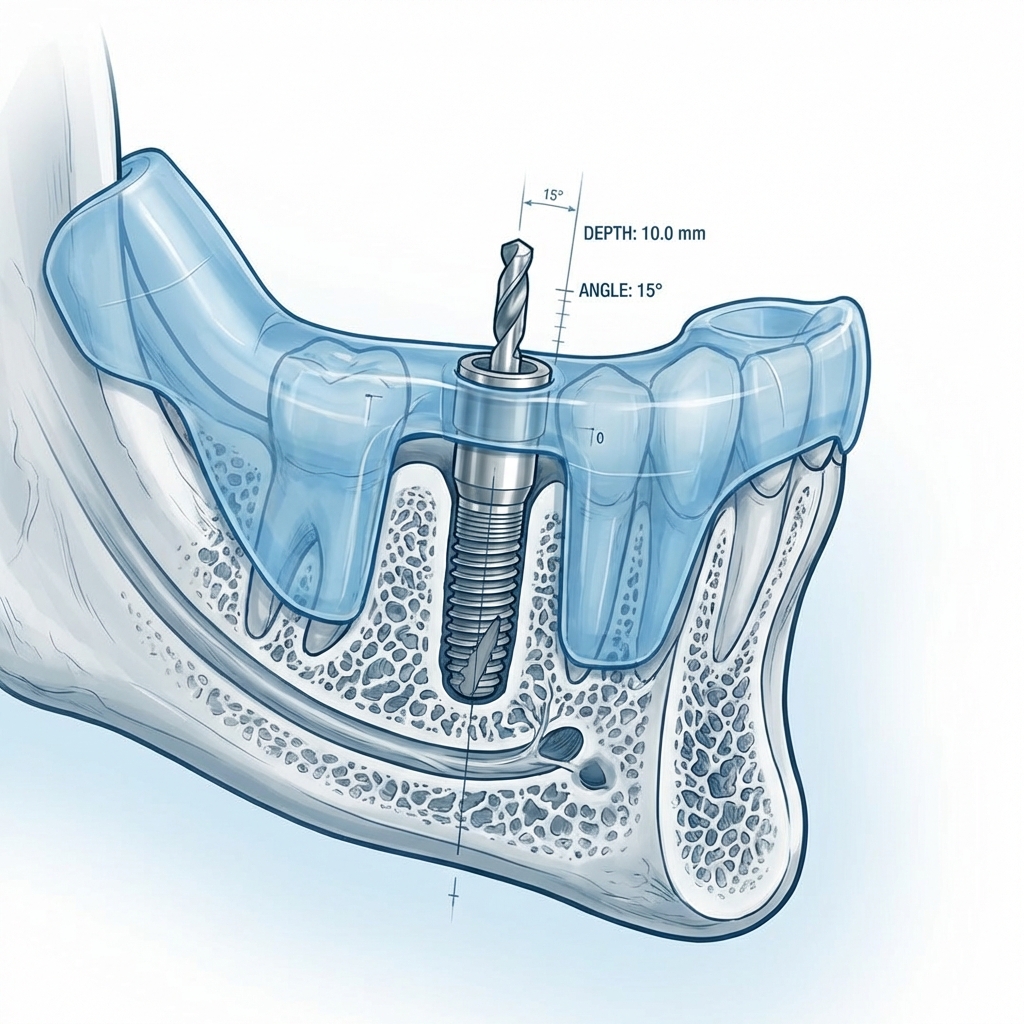
A 3D-printed template that fits over the patient's teeth or tissue and directs drill placement during implant surgery. It transfers the digital treatment plan into precise physical drill positions.
Guided implant surgery replaces guesswork with precision. By combining CBCT imaging, intraoral scanning, and digital planning software, clinicians can control every variable — implant depth, angulation, and position — before the patient even sits in the chair.
An implant placement technique that uses a physical surgical guide to direct drills and implants to positions planned in 3D software. It improves accuracy and reduces surgical risks compared to freehand placement.
A 3D surface mesh file format used in dental CAD/CAM. Intraoral scanners produce STL files that capture tooth and gingival surfaces for surgical guide fitting.
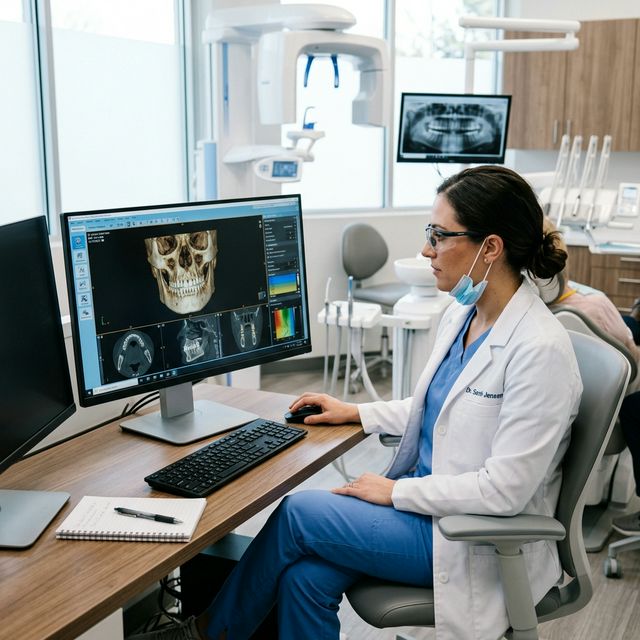
A 3D imaging technique that captures the jaw, teeth, and bone structure in a single rotational scan. It produces DICOM files used for implant planning, nerve mapping, and surgical guide design.
What Is Guided Implant Surgery?
In a guided workflow, the surgeon works through a custom-fabricated surgical guide — a 3D-printed template that snaps onto the patient's teeth or gums and directs the drill through pre-positioned metal sleeves.
Each sleeve corresponds to a digitally planned implant position. The drill follows a fixed path, eliminating the variability of freehand placement.
Why Accuracy Matters: The Numbers
Multiple clinical studies have demonstrated the advantages of guided surgery:
- Angular deviation is reduced to an average of 2.6° (vs. 7.8° for freehand placement)
- Apical deviation drops below 1.2 mm (vs. 2.4 mm freehand)
- Procedure time decreases by 30-50% due to streamlined preparation
- Complication rates drop significantly, especially in complex anatomical zones
For patients, this translates to less chair time, reduced swelling, and faster recovery.
When Guided Surgery Is Essential
While any implant case can benefit from a surgical guide, guided surgery becomes virtually mandatory in the following scenarios:
- Immediate loading protocols. When the provisional prosthesis is placed the same day, there is zero margin for positional error.
- Adjacent to vital structures. Cases near the inferior alveolar nerve, mental foramen, or maxillary sinus require millimeter-level control.
- Full-arch rehabilitation. All-on-4 and All-on-6 cases with tilted implants demand precise angulation that cannot be achieved freehand.
- Flapless surgery. Without visual access to the bone, the guide becomes the surgeon's only spatial reference.
The Digital Workflow: Step by Step
- CBCT scan captures the patient's 3D bone anatomy
- Intraoral scan (STL) records the soft tissue and teeth
- Digital planning merges both datasets to virtually place implants
- Surgical guide design translates the plan into a physical template
- 3D printing produces the guide in biocompatible resin
- Surgery proceeds through the guide with controlled drilling
How SurgicalGuide.Pro Fits In
At SurgicalGuide.Pro, we handle steps 3 through 5 of this workflow. You upload your CBCT and STL files, we plan the implants according to your specifications, and deliver a print-ready STL file of the surgical guide — typically within 24 to 72 hours.
Our guides are compatible with all major implant systems, including Straumann, Nobel Biocare, Osstem, Dentium, and MIS.
Ready to streamline your surgical guide workflow?
Join 200+ dental professionals who trust SurgicalGuide.Pro for precision planning.