Want to learn more about surgical guide planning?
Discover how digital workflows can improve your implant success rates.
Table of Contents
- What Has Changed in 2026
- Cloud-Based Collaboration
- Faster Turnaround
- Transparent Pricing
- Post-Payment Models
- Comprehensive Drilling Reports
- Multi-System Compatibility
- What to Look For in a Modern Service
- 1. Clinical Planning, Not Just CAD Work
- 2. Revision-Friendly Process
- 3. Communication Speed
- 4. Security and Compliance
- 5. Education and Support
- Where the Industry Is Heading
- AI-Assisted Planning
- Integration with Practice Management
- Real-Time Collaboration
The surgical guide design industry has changed dramatically in the past two years. What was once a niche service offered by a handful of specialized labs has become a mainstream option accessible to every implant dentist.
A 3D-printed template that fits over the patient's teeth or tissue and directs drill placement during implant surgery. It transfers the digital treatment plan into precise physical drill positions.
If you have not ordered a surgical guide since 2024, you may be surprised by what a modern design service looks like.
What Has Changed in 2026
Cloud-Based Collaboration
Planning is no longer done in isolation. Modern services provide 3D review links where you can inspect the proposed implant positions from every angle, suggest modifications, and approve the plan — all from your browser. No software installation required.
Faster Turnaround
Two years ago, 5-7 day turnaround was standard. Today, premium services deliver in 2-3 days standard and 24 hours for express cases. The improvement comes from better software automation and dedicated designer workflows.
Transparent Pricing
Hidden fees for "complex anatomy" or "multi-implant cases" are disappearing. The best services publish fixed per-case pricing — €80 for tooth-supported guides, €150 for All-on-X — with no surprises.
A full-arch implant rehabilitation protocol where 4-6 implants support a complete fixed prosthesis. It allows immediate loading, meaning patients receive teeth on the same day as surgery.
Post-Payment Models
Trust-based pricing has arrived. Leading services let you review the completed design before paying. This eliminates the risk of paying for subpar work.
Comprehensive Drilling Reports
A surgical guide STL file alone is no longer sufficient. Today, expect a complete drilling report including:
A 3D surface mesh file format used in dental CAD/CAM. Intraoral scanners produce STL files that capture tooth and gingival surfaces for surgical guide fitting.
- Step-by-step drill sequence per implant
- Recommended insertion torque values
- Sleeve specifications and kit compatibility
- Cross-sectional bone analysis at each position
- Emergency contingency positions
Multi-System Compatibility
Modern design services support all major implant systems from a single platform:
- Straumann (Bone Level, Tissue Level, BLX)
- Nobel Biocare (Active, Conical, Replace)
- Osstem (TS, SS, MS)
- MIS (C1, Seven, V3)
- Megagen (AnyRidge, AnyOne)
- Neodent, BioHorizons, Zimmer, and dozens more
What to Look For in a Modern Service
1. Clinical Planning, Not Just CAD Work
The designer should understand dental anatomy, prosthetic requirements, and surgical constraints — not just software buttons.
2. Revision-Friendly Process
Expect unlimited revisions before final approval. If a service charges extra for revisions or limits you to one round, find a different provider.
3. Communication Speed
In 2026, response times under 4 hours are the standard for quality providers. If you are waiting days for email replies, you are leaving faster options on the table.
4. Security and Compliance
Patient data protection is non-negotiable. Verify GDPR compliance, encrypted file transfer, and clear data retention policies.
5. Education and Support
The best services do not just deliver files — they explain their planning rationale. Look for providers who teach you, not just serve you.
Where the Industry Is Heading
AI-Assisted Planning
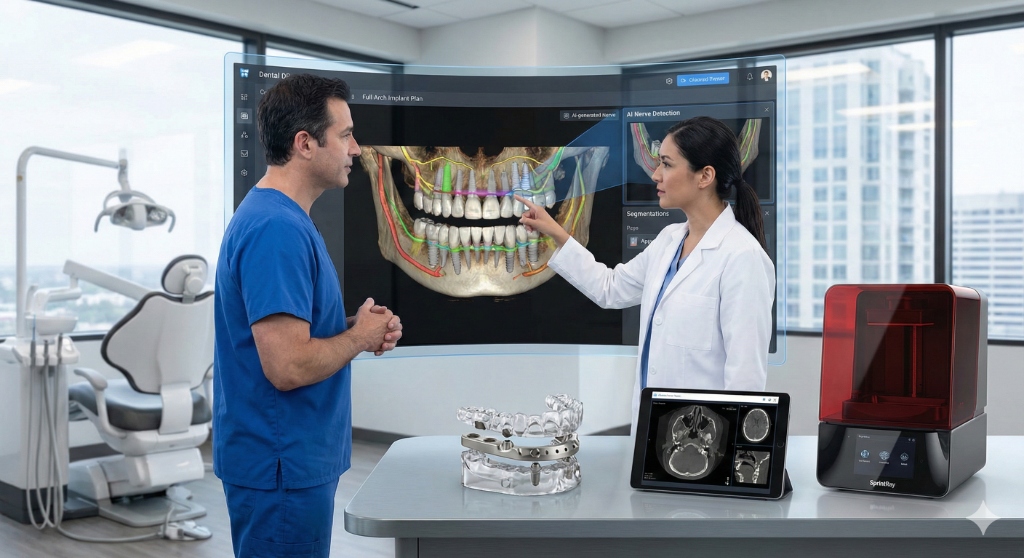
AI tools are increasingly used for initial implant positioning, automatic nerve detection, and bone density analysis. Human designers verify and refine the AI's suggestions, combining speed with expertise.
The structural quality of jawbone classified on the Misch scale (D1-D4). Higher density provides better implant stability; lower density may require modified surgical protocols.
Integration with Practice Management
Expect surgical guide ordering to integrate directly with your practice management software — upload files, track orders, and receive deliveries without leaving your workflow.
Real-Time Collaboration
Video-call planning sessions between surgeon and designer are becoming common for complex cases. This is especially valuable for zygomatic, full-arch, and immediate loading protocols.
A protocol where a temporary prosthesis is attached to implants within 24-48 hours of surgery, rather than waiting 3-6 months for healing. It requires high primary stability.
Ready to streamline your surgical guide workflow?
Join 200+ dental professionals who trust SurgicalGuide.Pro for precision planning.